The Right to Peaceful Protest: A Pillar of Democratic Governance as ConstitutionallyGuaranteed
Abuja, Nigeria: In light of recent events and ongoing discussions
surrounding the appropriateness of citizens expressing their dissatisfaction
with government policies and actions, we, the undersigned civil society
organisations, are compelled to reaffirm the fundamental right of citizens to
peaceful protest as a fundamental pillar of democratic governance. This right
is a cornerstone of any democratic society and a critical means for citizens to
express their dissatisfaction, demand accountability, and advocate for change.
Protestingisalegitimateformofexpressionenshrined in international human rights instruments,
including the Universal Declaration of Human Rights (UDHR), the International
Covenant on Civil and Political Rights, the African Charter on Human and
Peoples’ Rights, and Nigeria’s 1999 Constitution (as amended), among others. Itallows citizens to publicly voice their concerns,challengeinjustices,andparticipateactively
in thedemocraticprocess.
Protests serve as
a vital mechanism for holding leaders accountable and ensuring that government
actions reflect the will and needs of the people. History has shown that
protests can lead to significant changes in government policies, processes and
practices, highlighting the power of collective action to address grievances
and promote good governance.
While
the right to protest is a fundamental principle of democratic nations, we concede that it must be exercised peacefully and responsibly without
violating the rights of others.Accordingly, we urge allparties
engaged,includingprotest
organisers,participants, andlawenforcementagencies,toprioritisesafetyandtheruleoflaw.Lawenforcement has adutytosafeguardprotesterswhileupholdingpublicorder.Demonstrators
must avoid activities that might exacerbate tensions, cause unrest or threaten
public safety.
Attempts to
suppress demonstrations through intimidation, excessive use of force, or unjust
legal actions are unacceptable and counterproductive. Every protest is deemed peaceful, and if intelligence
indicates otherwise, it is the role of the appropriate government agencies to
identify such saboteurs and arrest them immediately. Arresting protest
organisers shows a lack of understanding of the enemies of the state.
We urge the
Nigerian Judiciary and the National Human Rights Commission (NHRC) to uphold
the rights of all protesters and establish a mechanism to promptly address and
dismiss oppressive charges that may arise from these protests.
The demands
include reducing the cost of living, curbing insecurity, reducing the cost of
governance, electoral reform, judicial reform, and constitutional reform, which
are all recurring themes in Nigeria’s journey towards a healthy democracy.
We reaffirm our
commitment totheprinciplesofdemocracyandhumanrightsandstandin
solidarity with those who decided to exercise the right to peaceful protest.
We encourage all
citizens to actively participate in shaping a just and accountable society, and
we call on all stakeholders to uphold the principles of democracy, human
rights, and the rule of law.
The Federation of Nigerian Mining Host Communities and its civil society
partners applaud recent attempts by the National Assembly, particularly the
efforts of the House Committee on Solid Minerals to amend the Minerals and
Mining Act of 2007, in an attempt to strengthen the legal and policy frameworks
to ensure the equitable distribution of benefits derived from the sector.
Previous to the current
bill Minerals and Mining (Repeal and Re-Enactment) Bill, 2023, we had on
numerous occasions advocated for the Act to be amended, particularly to reflect
the intent of Section 17(2)(d) of the Nigerian Constitution which provides that
“the exploitation of human or natural resources in any form whatsoever for
reasons,other than the good of the community, shall be prevented;” and Section
14(2)(b)and (c) of the constitution which states that the security and welfare
of the people shall be the primary purpose of government, and that “the
participation by the people in their government shall be ensured in accordance
with the provisions of this Constitution”.
In the light of these constitutional provisions, at the public hearing, we and
our civil society partners advocated for the following amendments, and are
holding this press conference to reiterate our stance. They are as follows:
1. The security and welfare of mining host communities are critical and must be reflected
throughout the amended Minerals and Mining Act. In particular, we called for:
2. The expansion of Environmental Impact Assessments to Environmental and Social Impact Assessments.
In addition to this, we
propose that the bill make a provision that compels artisanal and licensed
operators to conduct and publish bi-yearly impact reports of their mining
activities as a requirement for their continued mining operations with clear
penalties for default.
3.Inclusion of Civil Society Organizations and Mining Host Communities in state MIREMCOs. The proposed Section 9
which seeks to amend Section 19 of the Principal Act should be amended to
include a rotation of representatives of civil society organizations and mining
host communities as members of the Mineral Resources and Environmental Management
Committee(MIREMCO). This inclusion would foster greater transparency,
accountability,and community participation in decision-making processes. In
addition to having a representative of affected mining host communities and
CSOs, at each sitting where issues that impact their communities are discussed
as active participants in the process.
4.Chairmanship of, and Acknowledgment of State Autonomy in MIREMCO. We commend the proposed
amendment to Section 19(2)a of the Principal Act which gives the chairman of
MIREMCO to the State Commissioner of Solid Minerals and the autonomy granted to
state governments in MIREMCO is commendable, as it enables tailored approaches
to address regional challenges and priorities within the mining sector.
However, the problem of the funding of state MIREMCOs still exist and was not
properly addressed in the proposed amendment. We therefore recommend that
funding of state MIREMCOs should be housed in the Central Bank of Nigeria which
is independent of the State and Federal arms of Government.
5.Clarity and Specificity on the definition of the term “Community”. We also advocate
that this term to be inclusive of affected communities.
6.Clarity and specificity of the term ‘Community Development Associations’. The proposed
Section 33 which seeks to amend Section 116 of the Principal Act should be
amended to recognize that not all communities have an‘organised’ existing
community development association. As such, ‘association’as stated in this
subsection must be verified and approved by the state, with executive members
elected by members of the community, to be regarded as legitimate stakeholders
in the mining sector and authorised to receive the 5%derivative from mining.
This measure would ensure that there is a standard set for these associations
and to curb the issue of multiple associations claiming the right to receive
the 5% derivative. More so, the law needs more clarity on what the Community
Development Association is composed of, and what they would do with the
funds/the formula for utilizing the funds and ensuring transparency.
Also,determining the
leadership of the community with the authority to sign a CDA is another
consideration that must be had. State governments should ensure that host
communities are active participants in the Environmental and Social Assessment
process, and are equipped with access to the services of a lawyer,an
environmental impact expert, and a non-profit organization able to advise them
and vet agreements, to ensure their free, prior and informed consent before
agreements are entered into. Furthermore, wide consultations with all segments
of the community must also be reflected as having agreed to the terms of the
CDA before it is entered as signed.
7. Community Development Agreements(CDAs). CDAs do not presently
reflect environmental and social impact assessments or their recommendations.
Free, prior, informed consent must also be sought with the full import of the
EIA explained to the community before they agree on the terms of the CDA.
8.Regulation of Artisanal and Small-Scale Mining. We commend the inclusion of specific
provisions aimed at regulating the Artisanal and Small-Scale Mining Sector.More
than 80% of solid mineral mining in Nigeria is artisanal in nature.Effective
regulation is essential to promoting responsible mining practices and
safeguarding the environment and the rights of mining host communities. We
therefore recommend the development of artisanal mining regulation code in this
regard.
9.Separation of regulatory and administrative functions of the ministry. The ministry of
solid mineral development is currently saddled with the responsibility of
regulation and administration. We therefore recommend that these roles be
separated with the ministry solely responsible for the administrative functions
under the mineral and mining Act while the regulatory function be moved to a
unit created at the Federal Ministry of Environment.
10.Derivative Allocation for Mining Host Communities. We recommend the inclusion of the provision of a 5%
derivative for mining host communities, separate from the 13% allocation to the
state recognizing the integral role in mineral resource extraction and the need
for equitable Benefit-sharing.
11.Inclusivity in Board and Committee Composition. We recommend that the bill make deliberate provision for
gender, youths and persons with disability in the constitution of all boards
and committees established under the Act. This will ensure diverse perspectives
and representation, contributing to more balanced decision-making processes.
12.Completion of Social and Environmental Impact Assessments before Issuance of Licenses. We recommend that
the proposed bill amend relevant sections of the Principal Act to ensure
exploration title holders fully complete Environmental Impact Assessment before
mining licenses are granted.
Conclusion
The Federation of
Nigerian Mining host communities and its civil society partners commend the
efforts of the National Assembly to introduce legal reforms aimed at ensuring
equitable governance of the solid mineral sector. We insist that the proposed
amendments to the Act must better serve the interests of all stakeholders,
particularly mining host communities, promote sustainable development in the
mining sector and contribute to the socioeconomic advancement of our nation.
Signed,
● All state chapters of
The Federation of Nigerian Mining Host Communities
●
Centre for Community Excellence (CENCEX)
●
Change Partners International
●
Global Rights
●
Heroine Women Foundation
●
Initiative for Social Development
●
Keberkache Women Development & Resource Centre
●
Keen and Care Initiative
●
Methodist Care and Development Trust
● Neighbourhood
Environment Watch (NEW) Foundation
●
New Generation and Social Development Initiative
●
Srarina Initiative for Peace Justice and Development
●
Stephanie Peace Building & Development Foundation (SPADEV)
Issuedatthe2024South-SouthRegionalConferenceonImprovingRegulatory Environment for CSO Operations in Nigeria
Calabar,
CrossRiverState–Nigeria
CrossRiverState–Nigeria
Background
Global RightsincollaborationwiththeCommunity
ofPractice(COP)on Civic SpaceStrengthening and theEuropean
UnionDelegationtoNigeriaandECOWASconvened
the2024South-SouthRegional ConferenceonImprovingRegulatoryEnvironmentforCSOOperations
inNigeria.Thethemeofthe conference
was “Forging Partnerships for Sustainable Operational Environment for
Non-Profit Sector inNigeria”.ThehybrideventtookplaceinCalabar,theCrossRiverStatecapitalonthe27thofJune
2024withover200in-person
participantsandover50virtualparticipants.
Theconferencewasprimarilyfocusedondrivingcriticalconversationsamongstakeholdersonways of improving theregulatory environmentfor
the non-profitsector in Nigeriaparticularly tohighlight
theneedfortheharmonizationoftheCSOregulatoryframeworkatthesubnationallevelstoaddress
issuessuchasthemultiplicityofregistrationrequirementswithdifferentMDAs.Also,theconference
furthersoughttofacilitateasharedunderstandingoftheopportunitiesinextantlawsthatcould enhance CSO operationsat thesubnationallevel.
The Conference reflectedon efforts
to strengthen thecivicspaceand
improvetheregulatory environmentin
South-South Nigeria,particularly through theprojectpresentlyimplementedbyGlobalRightsincollaborationwiththeCommunityofPractice
Acknowledged
the pivotal role CSOs play in our society; agreeing that significant challenges
and overbearingstandardsmarkthelandscapeinwhichCSOsoperateinNigeria,particularlythe regulatorymultiplicityandregistrationrequirements.Theyagreedtoleverageamulti-sectoral
stakeholderengagement approach in facilitating a modelframework
forimprovingthe regulatory environmentforCSOoperationsinNigeria.
Reckoned sustained support of the European Union
Delegation to Nigeria and ECOWAS and commended
theeffortsofGlobalRights
andtheCommunityofPractice
(COP)onCivicSpace Strengthening and sustaining conversations
to promote an improved regulatory environment for CSOs in Nigeria. Underscoredtheneedfortheharmonizationofregulatoryframeworksatthesubnationallevel. ThepivotalroleofthelegislatureinfacilitatinganimprovedregulatoryenvironmentforCSO operationin Nigeria.
Furthermore,theconferencerecognize
TheimportanceofforgingpartnershipsbetweentheArmsofgovernmentandcivilsociety
organizationsinstrengtheningtheethosofdemocracyinNigeria. That the
multiplicity of registration requirements serves as a major bottleneck to the
operation ofCSOs,especiallyatsubnationallevels.
and legislations That the convergence
of processesfor registrationeliminatesmultiplicity, reducingcosts
and enhancing accountability and transparency. This partnership will
further infer trust, confidence,andcredibilityontheState. Theimperativeofco-creatingregulatoryframeworkwithinputsofcivilsocietyorganizations.
The lack of institutionalized framework for
coordination of CSO interventions at the subnationallevel.
●
The recentand
developingpractice of excludingState
andLocal Governmentregistered CSOs fromaccess to
bank accounts and,by
implication,other financialservices.This
is aresultof SCUML’s decision to discontinue its
onboarding/issuing of SCUML’s certificate to State/Local GovernmentregisteredCSOs.
will work in harmony with the civil
society organizations to adopt a regulatory framework that allowsasingle MDA
to registerCSOs
inthe States–suchamodelwillpromote theaccessibility neededforimproving
theregulatoryenvironmentforCSOoperations.
2)
Allstakeholdersincludingtheregulators,CSOs,legislature,anddonoragenciescommitto drivetheprocessofdevelopingamodelharmonizationpolicyorlawforCSOregistration requirements at the statelevel
with input from allrelevant stakeholders which will not only enhance
the operational effectiveness and efficiency of the sector but also provide opportunitytothestategovernmenttocoordinateCSOsinterventionswithinthestatebetter.
3)
Topromote
holisticinclusionineffortstoimprovetheregulatoryenvironmentforCSOs including paying attention to key actors, gender,
disabilityandotherparameters
Harmonizingregulatory
compliance requirementsandidentifying a unanimouslyagreed single bodyresponsibleforregisteringCSOsintheStatetoavoidmultiplicityofregistrationand
regulations.
workinconcertwiththeofficeoftheCommissionerofJusticeto proposeabilltoconferbodycorporatetoorganizationsregisteredatthestateandlocal government
levels based on the provisions of the 1999 Constitution, the judicial precedent
set bytheCourtofAppealandtheprincipleoffederalismoperatinginNigeria.
in Nigeria was a great opportunity for continued engagements between the
various arms of government,donorcommunities,theprivatesector,andCivilSocietyOrganizations.Theconference
Theconferenceservedasa
convergencepoint, bringingtogetheranarrayofstakeholders,
including civilsociety organizations, government representatives
including the office ofthe Governor of Cross River,OfficeoftheChiefJudgeofCross
River State,OfficeoftheSecretary totheCross
River State Government,OfficeoftheFirstLadyofCrossRiverState,theClerkoftheCrossRiverStateHouseof Assembly,CrossRiverStateHouseCommitteeonDueProcess,Anti-Corruption,InternationalDonor Support,
andSDGs,CrossRiver
StateMinistryofWomen Affairs,AkwaIbom
State MinistryofWomen AffairsandSocialWelfare,
CrossRiverStateMinistryofHumanitarianAffairs,
CrossRiverState Ministry of Social Welfare and
Development, Cross River State Ministry of International Donor Coordination,FederalInlandRevenueService(FIRS),CorporateAffairsCommission(CAC),Houseof RepresentativeCommitteeonCivilSociety
The team from GIFSEP, LEKEH,
SWAYA and Quest For Growth and Development Foundation visited Kaani Community, in Khana Local Government Area in Ogoni Land, Rivers State in the Niger Delta region of Nigeria. The essence of the visit is to ascertain the level of
electrification or the status of power usage in the community. On the ground, our findings, are that there is no Power or Electrification of any sort in the Community by the Government, whether State or Federal, unfortunately, this is
an Oil producing community in the Niger Delta region of Nigeria, and it is part of the communities that generate revenue for the State and Federal Governments
of Nigeria.
However, it is worth noting
that, this is a similar situation in most Oil-producing Communities, which are in most cases under-developed, have no jobs, high level of unemployment, lack good quality infrastructure, no social amenities, if there are, so little.
Having identified these gaps
in Powering up the Community, the Team with support from 350.Org Africa (AfrikaVuka) will ensure Solar light installation in this Community, to enable the community members to feel the power, use it to stabilize their businesses, in the market and the youths and women will be taught some of the technicality of installing solar, so that they can manage it themselves and probably start a
business in that light, hence green jobs for youths and women of the community, this will strive development and sustaining businesses and mitigate heatwave
from the impact of climate change. Schools were visited, including the Ken Saro Wiwa Polytechnic in Bori, Ogoni Land.
Global Rights calls on the management of the University of Ibadan to immediately rescind its expulsion of 3 students – namely Olamide Gbadegeshin, Aduwo Ayodele, and Nice Linus for engaging in a peaceful protest against the sudden hike in tuition fees by the University’s management. The 3 students, alongside one Olorunfemi Adeyeye, were apprehended by army officers while protesting the fee increase at the inauguration of the Student Union government on May 13, 2024. While their action may have posed an inconvenience to the administration of the university, extant laws clearly prescribe their right to protest peacefully. The 1999 Constitution of the Federal Republic of Nigeria, as amended, provides great latitude for expressions and actions that constitute peaceful protest, specifically, the rights to freedom of expression, assembly, association, and movement. It is also a well-recognized fact that peaceful protests, especially by young people, have often been an effective means of bringing about positive social change in democratic societies all over the World. A university of the calibre of the University of Ibadan should, therefore, not be averse to its students exercising this right. It is our considered opinion that educational institutions are afforded a vantage position in helping to build a rising generation of civic actors who have an increasingly important role in entrenching Nigeria’s democratic roots. Recognizing this important responsibility, one of the Nation’s premier educational institutions should not set a bad precedent by truncating these students’ right and access to education; rather, it should seek to allay their concerns and those of others who are rightly worried about the ability of Nigeria’s children and youth to access quality education in the current economic climate. We recognize that the University of Ibadan has a duty to maintain its educational standards and responsibilities to its tutors while navigating the harsh economic terrain, but surely, the university should understand why students will feel the need to protest a significant increase in tuition fees. Consequently, we ask: a. That any plans to expel Olamide Gbadegeshin of the Institute of African Studies, Aduwo Ayodele of the History Department (200 level) and Nice Linus from the University of Ibadan be immediately jettisoned.
b. The students should be allowed to resume their studies without any fear of intimidation, harassment, or reprisals from the management and staff of the University of Ibadan. c. The Security agents who arrested them and Olorunfemi Adeyeye on May 13, 2024, because they peacefully protested, should issue them a swift and unreserved apology. d. That the University of Ibadan lead the way for other tertiary educational institutions in Nigeria by engaging mechanisms that encourage ample and robust interactions with students. On our part, we stand solidly behind dissenting voices who choose to participate in their governance and seek social justice utilizing their freedom of expression through Peaceful Protest.
Global Day of Action: the world looks to China to halt EACOP
Who: The StopEACOP campaign and its allies are planning a coordinated global day of action on June 26th, 2024, outside the Chinese embassies and some of the Chinese financial institutions in 12 countries.
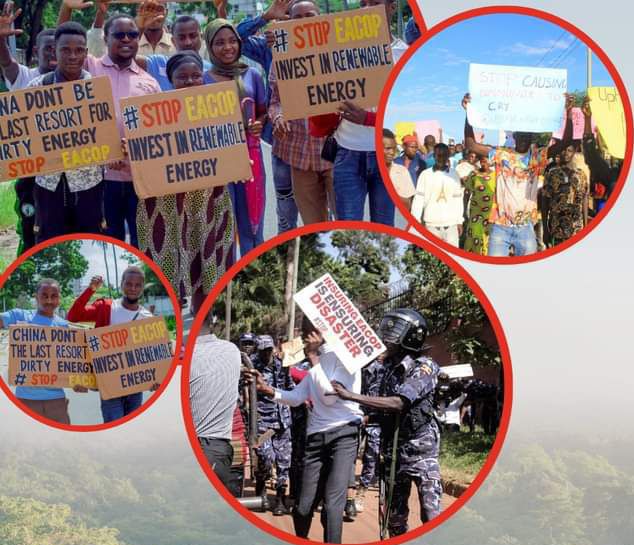
What: The StopEACOP campaign is coordinating an escalated global action to urge China to rule out financial support for the East African Crude Oil Pipeline and the associated oil field projects (the EACOP projects). The campaign specifically targets the China Export & Credit Insurance Corporation (SINOSURE), the state-owned Chinese insurance company, the Export-Import Bank of China (China Exim Bank), one of China’s policy banks, and the Industrial and Commercial Bank of China (ICBC), China’s largest commercial bank and one of the financial advisors for the EACOP project. The Chinese financial institutions have reportedly considered supporting the projects and are expected to make a decision in July. The day of action will hold peaceful protests outside Chinese embassies and consulates in cities in Africa, Europe, and the USA, demanding that Chinese embassies officially receive petitions signed by the affected people and studies about the impacts of the projects. This action is also a response to the recent abduction of Stephen Kwikiriza and arbitrary arrests of protestors in the previous demonstrations in November2023 and May 2024, showing solidarity with local activists and human rights defenders in Uganda and Tanzania who continue to resist despite facing repression.
In Uganda and Tanzania
Why: The EACOP projects pose outstanding risks and impacts to local communities’ livelihoods, water resources, and key biodiversity areas of East Africa while providing little benefit to the average Ugandan and Tanzanian. The projects, which are estimated to lead to greenhouse gas emissions of 379 million tonnes CO2e, are also a climate bomb that will fuel the global climate crisis, further locking the planet in a
fossil fuel future. As major financiers and insurers from North America, Europe, and Japan have publicly distanced themselves from the harmful EACOP projects, the project developers are now looking to China for financial support. Affected people and local civil society in Uganda and Tanzania have communicated their concerns to the major Chinese banks, insurers, and the Chinese government by sending letters, petitions and analyses, and more recently through peaceful actions at the Chinese embassies. The Chinese government and financial institutions have continuouslyrefused to respond to the demands of the affected people. However, there are signs that the Chinese decision-makers are aware of the significant risks of financing the projects. It has been reported that the delayed decision of the Chinese lenders, who have taken a prolonged time to assess the risks, has put the project in a cash crisis that threatens to stall the construction. The campaign aims to amplify people’s voices and urge China to make the right decision. As a committed climate leader and responsible development partner of the Global South, China should not enable these destructive projects, which are majoritively owned by TotalEnergies, through insurance or financing. Instead, China should invest in renewable energy projects promoting sustainable African development.
Where: The specific cities where these actions will take place include
Kampala, Uganda, on June 26th
Dar es Salaam, Tanzania, on June 26th
Kinshasa,DRCon June 26th Nairobi, Kenya on June 26th Abuja, Nigeria, on June 26th
Tshwane, South Africa, on June 26th
Paris, France, on June 26th
London, Manchester, UK, on June 26th
The Hague, the Netherlands, on June 26th Düsseldorf, Germany, on June 26th Copenhagen, Denmark, on June 26th
Washington DC, USA, on June 28th (by the Ugandan Diaspora in the U.S.)
Interview Opportunities:
To arrange interviews with spokespeople from organizing groups or for more information about individual actions, please contact:
Edosa Oviawe (Global Rights Nigeria-Program Manager)
By Smith Nwokocha
On 3rd May 2024, the global community commemorated World Press Day (WPD), which provided an opportunity to celebrate the fundamental principles of press freedom and assess the state of media freedom worldwide. Though the 2024 theme was on informing the public about the problems and solutions facing the environment and influencing concrete action to address pressing environmental problems in Nigeria, this year’s WPD came at a most perilous time for the freedom of the press in the country. Hence, the major conversations and engagements in Nigeria on May 3, 2024 highlighted recent experiences in Nigeria, indicating that press freedom is under threat, and there is a need to raise the bar for a free press in the country. We are witnessing increased deployment of state resources and the weaponization of state institutions in the attempts to gag the press in Nigeria.
Section 39 of the 1999 Constitution of Nigeria (As Amended) recognises and guarantees Freedom of Expression and the Press as a fundamental right, and Section 22 of the 1999 Constitution of Nigeria (As Amended) places the burden on the press to uphold the government’s responsibility and accountability to the people. Similarly, other international treaties and conventions, of which Nigeria is a signatory, recognise the right of the press as fundamental to the existence of democracy.
However, since the beginning of 2024, there has been an alarming surge in incidents of unwarranted arrests of journalists, mostly for revealing corruption cases and governance failures. There is the increased deliberate use of the Cybercrimes Act to stifle press freedom in Nigeria. Ironically, there is the continued application of Section 24 of the Cybercrimes Act 2015, which has been repealed in the Cybercrimes Prohibition, Prevention Act 2024 (As Amended) passed into law in February 2024 to arrest journalists. For instances, on 7 February, 2024 the Kwara State Police charged Salihu Ayatullah, Editor-in-Chief of Informant247, Managing Editor Azeez Adisa Jaji, and reporters, Abdurahman Taye Damilola and Salihu Shola Taofeek, with conspiracy and defamation under the Cybercrime Act, and the Penal Code respectively. The charges stemmed from a report alleging that the Kwara Polytechnic Rector, Mr Abdul Jimoh Mohammed made false financial claims and commissioned uncompleted projects. On 23 March 2024, Bukky Shonibare, Chairperson of the Board of Trustees for the Foundation for Investigative Journalism (FIJ), was summoned by the National Cybercrime Centre of the Nigerian Police Force and interrogated on 26 March after which she was asked to produce FIJ’s publisher, Mr. Fisayo Soyombo, over his revealing report of alleged corruption and arms dealing by personnel of the Nigeria Customs Service. On 1 May 2024, Daniel Ojukwu, an FIJ reporter, was arrested in Lagos and taken to the State Crime Investigations Department before being transferred to the National Cybercrime Centre in Abuja. He was detained for 10 days over allegations of cybercrime, following a report on the misappropriation of public funds by Mrs Adejoke Orelope-Adefulire, the Special Adviser to the President on Sustainable Development Goals (SDGs). On 15 May 2024, Nurudeen Akewushola, a reporter with the International Centre for Investigative Reporting (ICIR), received a letter from the Police Cyber Crime Centre (PCCC) inviting him for an interview arising from a petition following an ICIR report. The same day, another letter invited ICIR’s managing directors for a similar interview. This list of attempts to hound journalists and gag press freedom in Nigeria tends to be increasing by the day.
It has been reckoned globally that the beacon of democracy is, in fact, a free and fair press. Freedom of the press is respected because it is indeed the ultimate value of any democracy. Democracy is about citizen’s participation in governance; the fulcrum of that freedom is freedom of expression. The media, both conventional media and new media, play a crucial role in this. They are the vehicle or channel through which citizens can express their views, hold the government accountable, and participate in the democratic process.
Nigeria’s President, Bola Ahmed Tinubu, recently in his 2024 Democracy Day speech not only celebrated the nation’s progress but also enumerated his administration’s commitment to entrenching democratic values and economic reforms. The President, while paying tribute to some media organisations for their fight and doggedness for a return to democracy during the military regime, noted that “we could not have won the battle against military dictatorship without the irrepressible Nigerian journalists who mounted the barricades along with the pro-democracy activists”. These very profound words of the President now leave one to wonder: If the Nigerian Press is so important to this democracy, why are journalists increasingly becoming victims of law enforcement and security agents’ harassment under his watch?
Press freedom is not just about protecting journalists. In fact, when press freedom is in jeopardy, it means the citizens have lost their basic freedom to participatory governance. If citizens ever needed to rise against tyrannical tendencies by those who wield state powers against its citizens, now is that time.
A country’s democracy is only as good as its citizen’s ability to freely live, move, associate and express their views without fear. All Nigerians must therefore rise up in defence of press freedom in the country; Journalism Is Not A Crime!
Edosa Oviawe
A Human Rights and Governance Advocates and currently the Program Manager for Global Rights
Culled from Rivers State Ministry of Health X handle:
#Cholera Status Report in Rivers State – “No Active Cases Reported but we are in heightened surveillance.”
“In the past couple of days, there have been nationwide reports about #Cholera outbreaks across some of the states in the country. I would therefore like to share a brief update with the public on the status in Rivers State.
On the 9th of June 2024, the Rivers State Public Health Emergency Operation Centre (@RiversPHEOC) received notification of some suspected cases of Cholera disease outbreak at Ngo in Andoni Local Government Area (LGA).
@RiversPHEOC was further notified of two associated dead in the community with similar symptoms by the LGA Rapid Response Team (RRT) led by the State Disease Surveillance and Notification Officer (DSNO). The State RRT mobilized to support the LGA RRT to ascertain diagnosis, manage and contain the incident.
I wish to emphasize here that there are currently NO ACTIVE CASES reported.
The State Surveillance Team carried out the following:
◀️State surveillance team comprised of the State Rapid Response Team (State RRT), Primary Health Care team, LGA RRT, representative of the World Health Organization, visited the affected Ngo community.
◀️Advocacy visits to community leaders (Chiefs/leaders, religious group leaders, women leaders) and affected households.
◀️Conducted detailed case investigation, collected samples for definitive diagnosis.
◀️Recruited and trained volunteers for Active Case Search in the settlement.
◀️Health education to community members on health-seeking behaviour (to go to a health facility for treatment in the event of feeling unwell).
◀️Carried out Active Case searches at the catchment health facility and randomly in the community.
◀️Community sensitization on preventive measures.
◀️Demonstrated and built capacity of Surveillance and Risk Communication personnel (ACS team) on water purification methods.
◀️Water samples were collected from common well sources and cisterns already used for drinking by the affected households for physio-chemical and biological analysis.
Case management
◀️Suspected cases were managed at General Hospital, Ngo and the team interacted with the doctors who were available at the time of the visit.
◀️Review of the cholera case management protocol for common understanding.
◀️@MoHRiversState supported the facility with Medical Consumables, IEC materials, IPC commodities etc.
Cholera
◀️Cholera is a highly contagious gastrointestinal disease which causes severe diarrhoea and can be life threatening due to the severe dehydration that can ensue. It often arises following the ingestion of contaminated water in places with poor water, sanitation, and hygiene.
◀️Symptoms include severe watery diarrhoea, vomiting, abdominal cramps, fever, and collapse in some cases.
◀️Treatment includes rapid correction of the massive fluid loss through oral rehydration solution (ORS), or intravenously by medical personnel in hospitals in severe cases.
Preventive measures include:
◀️Ensuring safety of water for drinking and cooking by boiling, chlorinating, or using bottled water. Avoid ingesting water from untreated sources.
◀️Proper sanitary measures such as safe disposal of faeces, and avoidance of open defecation.
◀️Good hygiene measures such as regular handwashing with soap and clean water, especially before preparing food, eating, and after using the toilet.
◀️Relevant information is available from the Rivers State Ministry of Health, the Nigeria Centre for Disease Control (NCDC) and accredited local facilities for guidance, and updates on prevention, treatment, and management.
◀️Suspected cases can be reported for necessary follow-up via direct lines of Disease Surveillance and Notification Officer (DSNO) 08124124792 and the State Epidemiologist 08033124314.
@MOHRiversState therefore reiterates that our situation is currently NOT ACTIVE, but we are in a heightened surveillance.
We will continue to keep the public informed as we monitor the ongoing situation, as the administration of His Excellency Sir @SimFubaraKSC is deeply committed to ensuring the health and wellbeing of all citizens and residents of Rivers State.
We therefore encourage everyone to prioritize the preventive measures, and report any suspected cases promptly, as these will be crucial to protecting the public from infection and safeguarding our communities.
Thank you and God bless you.”
Dr @Adaeze_Oreh, Honourable Commissioner for Health in Rivers State.
Note: Information Disorder affects all of society, which include individual, family, community, public health, and society. We all have a role to play.
HISTORY AND EVOLUTION OF INFORMATION DISORDER LEADING TO INFODEMICS:
Pre-Internet Era
20th Century Development
Transition to the Digital Age.
INFODEMICS AND THE MEDIA:
Infodemics is an event, that leads to information disorder-overload of information. The rise of the internet changed everything, including the way we communicate. Social media is new order. Algorithm is the New Editor. Infodemics threatens the Media, making the Media to fight Trust. Fighting Infodemics is the integral work of the Media because it threatens the profession.
Understanding Infodemics in a Digital Age.
INFODEMICS AND HEALTH
“Once there is no trust, infodemics will thrive. We must work to address this new challenge”. Hannatu Bello.
Undermining Trust in Public Health Measures:
In some countries, misinformation has generated mistrust in Government, Public health Authorities and Science. Promotion of harmful practices. Stigmatization and Discrimination. Overwhelmed Healthcare Systems. During Ebola outbreak, there were rumuors…
INFODEMICS AND THE POPULATION
Infodemics and disease outbreaks have complex and intertwined relationship.
Relationship between Infodemics and Disease Prevention and Control.
Relationship between Infodemics and Governance
Mitigation Strategies
HIGHTLIGHTING DAY 2:
Module 2: Information Ecosystem and Motivation for Infodemics:
What is Ecosystem: The interconnected network of various sources, channels, and platforms that facilitate the creation, dissemination, and consumption of information within a particular order. The ecosystem includes traditional media outlets, social media, websites, individuals, Organizations, Governments, and other entities that contributes to the production and flow of information and influence how it is accessed and understood by the community or audience.
Elements of a Community Information Ecosystem:
Infrastructure, Skills, Supply.
Key Players in the Information Ecosystem:
Information producers, Information consumers, Media platforms and Channels, Information intermediaries, Regulatory and Policy framework, Technology, and Infrastructure, Cultural and Social Dynamics, Economics Factors, Public Health and Crisis Communication Strategy, Community Engagement and Citizen Participation.
Infodemics Cake Model:
Science, Policy/Healthcare Practices, News Media, social media, and Community.
Motivation and Impact of Infodemics:
Motivation For Infodemics: Ideology, Politics, Radicalization, Profit, Status, Attention, Humour, and Harm.
Driving Factors that Sustain Infodemics: Technology, Psychology, Language, and Info-void.
Impacts of Infodemics: Population, Cross-cutting, Media and Health.
Addressing the Impacts of Infodemics:
Public Education, Media Literacy, Fact-Checking, Digital Platform Accountability, Ethical Content Moderation, Regulatory Frameworks, Global Collaborations, Responsible Journalism and Transparent Communication from Authorities.
Fact-Checking: How can fact-checking address the impact of infodemics.
INFODEMICS AND THE AUDIENCE:
Your strongest relationship in life is your relationship with information. Language is one of the strongest links to audience.
Shaping the Content.
Behind Audience Segmentation:
Audience Profiling: an Audience Profiling helps describe a member of the audience as a “typical person” representing the audience segment. An audience profile can be developed for all prioritized audiences- primary and influencing.
Offline Audience Profiling
Online Algorithm.
“Knowing Your Audience through Infodemics Lens”.
“Health News is not always exciting, but when you look at it from the Audience Lens, it becomes exciting”. Mr. Oliver Lorkase.
Enhancing Video Storytelling: Tips and Techniques for Creating Engaging Visual Content:
Impact of visual storytelling on Journalism: Enhancing News Delivery, Story Amplification, Audience Reach and Relevance.
Visual Storytelling Techniques: Narrative Structure, Visual Consistency, Data Visualization.
Techniques for Compelling Video Narratives: Strong Narrative Arc, Keep Your Target Audience in Mind.
Considering the Four P’s of Storytelling: 1) People 2) Plot 3) Place 4) Purpose.
INFODEMIC DYNAMICS AND CRISIS MANAGEMENT:
“Everything happens in a community, and it enables one categorize the Actors.” Dr. Yahya Disu.
What is Infodemic Dynamics? Infodemic dynamics refer to the complex and often rapid interactions, processes and phenomena that occur with an infodemic.
Infodemic Dynamics and Crisis: Generation, Momentum and Dynamism.
Digital Influence on Behaviour: information Algorithm and Personification, Language use, Cognitive Psychology.
Crisis Management: It refers to the process of preparing for, responding to, recovering from, and learning from crises or critical incidents that can significantly impact an organization, community, or society. Effective Crisis Management: involves proactive planning, rapid responses, communication strategies, resource allocation, coordination, and continuous improvement.
Pillars of Crisis Management: Prevention (Minimize), Preparedness (readiness), Detection (early warning), Response (mitigation and restoration).
MANAGING INFODEMICS, NIGERIA’S EXPERIENCE: INFODEMICS STRUCTURE AND SYSTEMS-STRATEGIES FOR MANAGING INFODEMICS.
Three (3) things’ standouts in managing infodemics: 1) Strategies 2) Principles 3) Approaches, aimed at mitigating the spread of mis-information.
Nigeria’s Approach to Infodemic Management:
Nigeria Infodemic Management Team (NIMT) in 2020, established to manage misinformation about disease outbreak (e.g COVID-19).
Social Media Health Influencing My Experience (Chinonso Egemba aka Aproko Doctor):
Some insights:
People love stories.
Social Media platforms are more of sensationalism and your clicking/scrolling is the currency.
Do Relatable Stories, Ask Questions, Put Specific Numbers, “Videos you don’t plan, gov viral easily than planned videos”.
In targeting the Audience: “Communication is effective, when it’s both ways”. You have to make your audience feel like they belong to a Community and it’s easier to influence in such manner. TikTok is like the next University.
In creating content, don’t put yourself first, rather your audience. “Mis-information” happen in social media, because social media is not regulated.
MANAGING INFODEMICS: STRATEGIES
Facts or Fictions?
What are the factors for the anticipated severity of misinformation and disinformation?
Note: “The reason A.I is used to counter misinformation, is because A.I created the problem of misinformation.” Abara Erim.
Technological Advancements (N/B: “Those who will lead the future, are those who lead in Technology”).
Elections and Political Processes.
Societal Polarization
Economic and Social Vulnerability
Persistent Technological Evolution
Regulatory Challenges
Global Fragmentation
Environmental and Geopolitical shift.
Infodemic is more than mis-information.
Information void- Questions-Concerns-Misinformation-Disinformation.
Infodemics Affect All of Society: Individual – Family – Community – Sectors
Managing Infodemics involves a Multifaceted Approaches: First level = Individual, Next level = Interpersonal/Community/Groups and Final level = Institutions/Structures/Systems. All are centered on “Information”.
Infodemic Management Approach: Prebunking, Innoculation and Debunking. Note: “If you have to sell, tell stories”.
Reflection Video.
Fact-Checking: Practical Steps and Sources. (Africa Check)
Myths and Facts
Fact-Checking: It is an important part of Journalism. It is a process of verifying information. Available data, Media Accuracy, Evidence-based public debate, Policy, and decision making. “People make decisions based on the information they have”. Allwell Okpi.
Tips on Identifying Information Disorder:
Develop a critical mindset, Check the source, the author, the publication.
Determine whether others are reporting the same news, Sensational headlines are red flags.
Ask yourself why this was created, Don’t take online photos and videos at face value, Check the facts, examine the evidence and ask the Experts.
5 Steps Fact-Checking Process:
Identify the original source and verify the content.
Define the terms and concepts within the claim.
Inspect the evidence using the latest reliable data.
Ask the Expert.
Set out your evidence.
Note: You must always have your goal in mind-the public-
Tools: Copyleaks AI Content Detector, Zero GPT, Deepfake Detector, We Verify
SEO?
Keyword Targeting, High Quality Content, Mobile Friendly Design.
Mr. Allwell Okpi (AFRICA CHECK)
VACCINES AND INFODEMICS
All about Vaccines. What ingredients go into a vaccine? There are broad range of different types of vaccines, but one thing they usually have in common is that they are inherently….
A Typical Vaccine Roadmap for drug Clinical Trials:
Step 1: Exploratory – Research
Step 2: Pre-Clinical – Safety and Efficacy
Step 3: Clinical – Safety and Efficacy in Humans.
Step 4: Regulatory Review and Approval – Licensure.
Step 5: Production – Scaling up.
Step 6: Quality Control – Performance, review.
What is Drug Trial?
Drug trials are clinical research trials conducted to evaluate the safety and efficacy of various drugs in human subject.
Blinding, randomization, adequate power, and a clinically relevant population of patients are considered the hallmarks of high-quality drug trials.
Stages of Drug Trial?
Phase 1: Screens the investigational drug for safety.
Phase 2: The experimental drug testing takes place within a larger group of participants (typically 100 to 300) to determine its efficacy and to further evaluate its safety.
Phase 3: Conducted to obtain final confirmation of its safety and effectiveness.
Phase 4: Take place following the approval of the drug sold in the market and provide additional evidence regarding the risks, benefits, and optimal use of the drug.
How does vaccines works?
How does the body respond to pathogens?
What do antibodies do?
So antibodies will attack any virus?
No antibodies are made to target one specific pathogen, just like a lock that can only be opened by one specific key.
What happens after the illness is over?
After the first infection, the immune system remembers how to protect the body from that specific pathogen.
Where do vaccines come in? Vaccines help the body resist future occurrence…
Definition of Terms
Vaccination, Immunization, Herd Immunity and Vaccine Hesitancy.
Dr. Olayinka Umar-Farouk (Breakthrough ACTION-Nigeria and Resident Advisor)
ADDRESSING VACCINE MISINFORMATION:
“Communication is an Art and it takes practicing” Dr. Olayinka Umar-Farouk
Why do we worry about Vaccine Acceptance?
Vaccines are one of the most effective life-saving interventions in history of mankind and prevent millions of deaths each year.
Vaccination Acceptance Continuum.
What influences a person’s Vaccine Acceptance?
5 C’s of Vaccine Acceptance.
How can we support our audience to make the best decisions for vaccination?
Empathy: Empathy is critical to building trust. Providing information and data is not enough to build trust.
Active Listening: is a way to listening and responding to another person that improves mutual understanding.
Persuasive Communication: Basically, it means communication that is aimed at creating, reinforcing, or changing people’s belief or actions. “The essence of Persuasion is Strategic Thinking”.
Note: “Adapt Your Communication with Your Audience”..Dr. Olayinka Umar-Farouk.
Tips to Address Vaccine Misinformation Know Your Audience, Segment them, Understand Them and Bucket Them.
Communication is two-way: Message, Messenger, Format, Frequency and Medium.
“The Messenger is as important as the Message”. Dr. Olayinka Umar-Farouk.
“Empathy can transform disagreement in real life into productive talk”.
In Summary, Addressing Misinformation:
Provide the Science, Use clear and shareable and easy to modify content and reference trustworthy.
“It’s all about focus and focus demands sacrifice”.. Eze Eze.
Dr. Disu Yahya, Milliscent Nnwoka and Akproko Doctor a Badge Induction into Faculty of Media EIS Fellowship
THE ROLE OF MEDIA INFOMEDIC MANAGEMENT
Information Dissemination, Stimulating Discussion and Citizen Participation.
Educational Role, Countering Disinformation, Collaboration with Authorities.
Building Resilience Against Misinformation:
Media Literacy, Health Literacy, and Infodemic Literacy.
AFCON SOCIAL MEDIA CAMPAIGN REPORT
What has been done (January to February).
Social Media Analytics
What worked:
Organic dissemination of posts, Posts felt natural, Influencers used multiple languages, Multiple ways to promote the life course approach, and Availability of SBC materials.
S.W.OT.
Lessons learned.
Humanize Social media content.
Reflection Video
Other Business and updates for fellows.
ACKNOWLEDGING THE FACILITATORS (FACULTY OF MEDIA EIS FELLOWSHIP)
USAID’s Breakthrough ACTION-Nigeria Project Drives Positive Health Changes Across Nigeria
A red carpet arrival kicked off the celebration of seven years of dedicated service and striking improvements in health areas ranging from maternal and child health to nutrition to malaria prevention and beyond. During a transition and learning event in Abuja on June 5, 2024, the Breakthrough ACTION-Nigeria project officially transitioned efforts and results to government agencies and community
organizations.
The Breakthrough ACTION-Nigeria project works under the leadership of Johns Hopkins Center for Communication Programs and is funded by the United States Agency for International Development (USAID). It has been at the forefront of applying social and behavior change, an important public health intervention that changes health outcomes. Since 2018, the project worked hand-in-hand with federal and state Ministries of Health and local organizations in 12 states and the Federal Capital Territory.
At a total investment of more than $100 million dollars over seven years, Breakthrough ACTION-Nigeria was the largest social and behavior country program ever funded by USAID/Nigeria.
The ceremony put a spotlight on Breakthrough ACTION-Nigeria’s achievements and the support it has provided to the Government of Nigeria’s Health Sector Renewal Strategy. This one-day event brought together esteemed government dignitaries, ministries, departments and agencies, donors, media from across Nigeria, programme champions, and representatives from the President’s office.
Health indices in Nigeria have been driven by many factors. The public health approach, social and behavior change identifies what individuals and communities believe and how they behave, then develops innovative strategies so they can adopt healthier behaviors and access vital health services. Since it started working in Nigeria, the project used a multifaceted approach—including mass media, community outreach, and user-driven social media campaigns—to inspire long-lasting change. These efforts resulted in positive changes across several health areas including reproductive, maternal, newborn and child health, nutrition and malaria, tuberculosis and COVID-19 vaccine uptake.
Among countless other findings, Breakthrough ACTION found that women who participated in community activities were significantly more likely to practice multiple preventive behaviors compared to women who did not participate, including at least four ante-natal visits during pregnancy, delivering in
the safety of a health facility, exclusively breastfeeding, consuming a diverse diet and receiving preventive malaria medication at least 3 times during pregnancy. Breakthrough ACTION-Nigeria’s commitment extended beyond designing and carrying out new approaches to changing people’s health behaviors. With a future-driven vision, the project also prioritized working with Federal and State Ministries, local partners, groups, and communities to sustain the positive behavior changes fostered over the past seven years. “With USAID’s and PMI’s support, we have had the privilege to improve the health and well-being of people across Nigeria. Because of what we have done together with our partners, pregnant mothers are accessing antenatal care, families are sleeping under life-saving mosquito nets, and children with previously undetected cases of tuberculosis are getting treatment. Together, we have saved and improved the lives of millions of mothers, fathers, children, and babies across Nigeria.” Dr. Shittu-Abdu Aguye, Breakthrough ACTION-Nigeria Project Director. The June 5 event included a red-carpet arrival, a gallery walk showcasing Breakthrough ACTION-Nigeria’s innovative interventions, a special guest plenary address, and a panel conversation with national and state representatives about the future of social and behavior change within Nigeria’s Health Sector Renewal Strategy.





 PHwakawaka